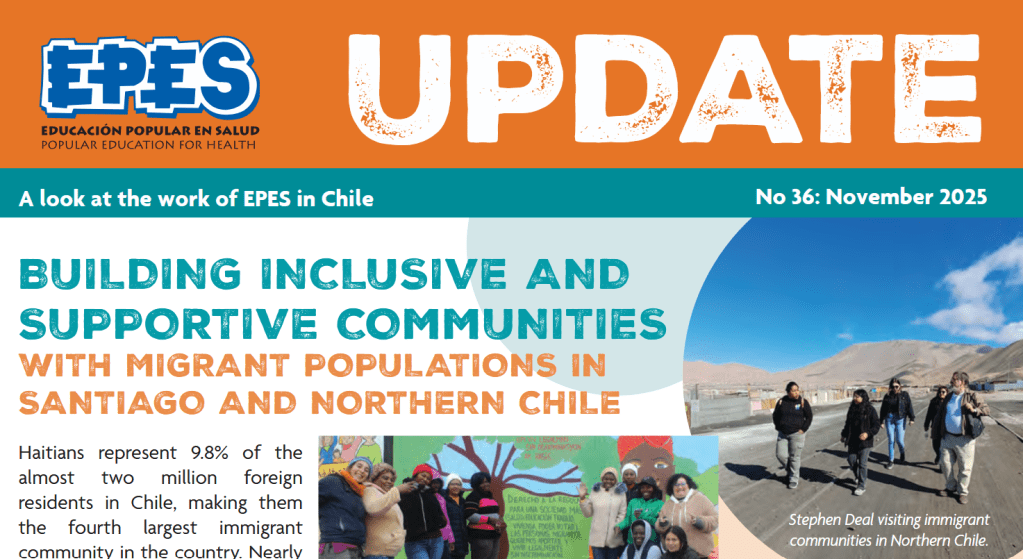
EPES Update – Fall/Winter 2025

Dear friends of EPES,
As I write this, Chile is in the midst of presidential elections, and we do not yet know whether Chile will continue to improve conditions for its people or revert to Pinochet-era policies. It is a tense time for many Chileans. None of the candidates achieved an absolute majority in the November 16 election, so there will be a runoff election between the leading two on December 14. Barring an historic increase in turnout by voters who oppose the right but for whatever reason refrained from voting in November, it is quite possible that the far-right candidate will win, with the other right-wing candidates throwing their support behind him.  

Such an outcome would have negative impacts in all areas of social justice, but would be particularly devastating for Chile’s migrant communities. In this Update, you’ll read about EPES’ efforts to build inclusive and supportive communities among migrant populations: the second edition of its Spanish Course for Haitian Women in Santiago, and its partnership with the Assembly of Migrants and Pro-Migrants of Tarapacá to develop humanitarian aid initiatives for migrants on Chile’s northern border.

EPES has been remarkably successful in working at both practical and policy level addressing people’s immediate needs while advocating for systemic change. The Update describes a prime example of this: their Food, Justice, and Health project, which builds awareness of the food system and the climate crisis, while building individual skills and community capacity to ensure sustainable nutrition and defend the human right to food.

You may recall that on July 4, 2018, a 21-month-old infant died in the emergency room of a Valparaíso hospital, waiting for a bed in intensive care. Amelia’s death motivated her parents to lead a national movement demanding improvements in health services, including equitable access. As one result of that campaign, Chile passed a law establishing July 4th as the National Day for Dignified Health. The Update reports on the celebration of the legislation taking effect this year.

November 25th is the International Day for the Elimination of Violence Against Women, so it is quite fitting that this Update includes an item on EPES’ ongoing commitment to combat gender-based violence, in coalition with other national and local organizations. This year, the 19 th Beware, Machismo Kills! Campaign uses the slogan: “The Far Right Takes Away Rights. Don’t Be Fooled!”—highly appropriate during the month of a national election in which the right threatens to win.

Also related to the theme of violence against women is the Update’s report of a commemorative ceremony honoring women who were executed extrajudicially or disappeared during the dictatorship. It is chilling to think that among the candidates for Chile’s presidency are people who approve of the military dictatorship (one of them going so far as to say, “If Pinochet were alive, he’d vote for me”).

Finally, the Update describes EPES’ work to address the needs of older women and their right to health and a life free of violence.

The wonderful American poet, Adrienne Rich, once said, “If you are trying to transform a brutalized society into one where people can live in dignity and hope, you begin with the empowering of the most powerless. You build from the ground up.” That, for me, encapsulates what EPES has been doing for more than four decades: building from the ground up, with women, with migrants, with those who are left out of the calculations of the powerful. And it’s only possible because of YOU—please accept our profound thanks for your steadfast and ongoing support of EPES’ efforts on behalf of health, dignity and justice for all.

In solidarity and peace,

Christina Mills MD FRCPC

Board President

PS Also, please join us in welcoming two new members of the Board of Action for Health in the Americas: Celia Higueras and Alina Stevenson.
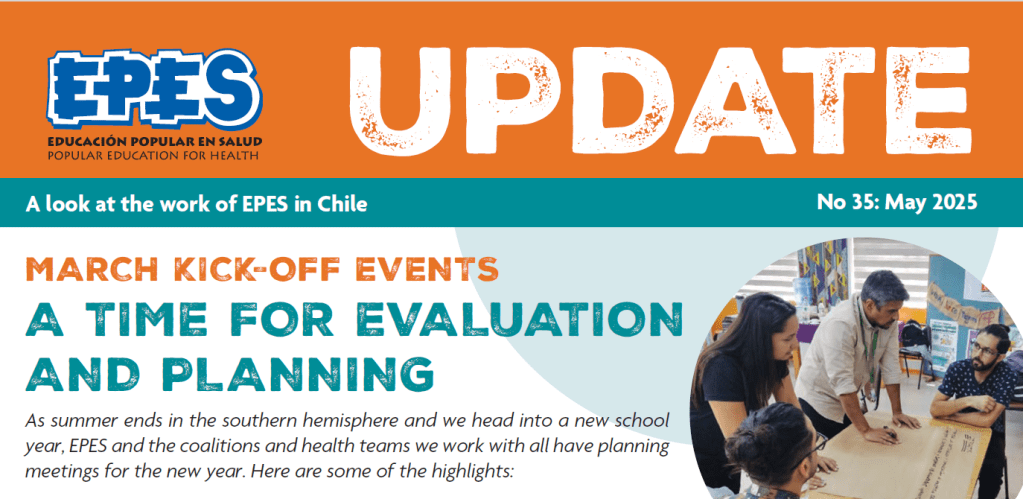
EPES Update – Spring 2025!

Dear friends of EPES,
In these turbulent times, I find it comforting to witness examples of people moving forward and working to create a better world, amid and despite the uncertainty.

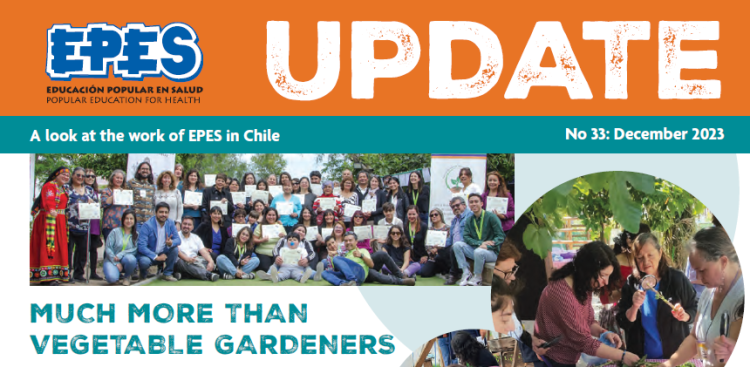
That is why I find the work of EPES so inspiring: In the face of dictatorship, earthquakes, fires and floods, they have persisted for more than four decades in the quest for health and dignity for all. In this Update, you’ll read of EPES’ ongoing work on food sovereignty and community gardening, strengthening community action for women’s rights, and defense of migrants’ rights.

And not just on the local and national scene. As you’ll read in this Update, they have shared their local experience and taken their advocacy for migrants’ rights to international forums: the Second Regional Review of the Implementation of the Global Compact for Safe, Orderly and Regular Migration in Latin America and the Caribbean, and the International Congress on Migration and Human Mobility. The Update also includes a salute to EPES Concepción, which closed its doors in January.

Its legacy will live on in the women whose lives have been transformed by their involvement with EPES and who continue to exercise leadership for change in their communities. Finally, the Update of course includes a report on the 14th International School of Popular Education and Community and Participatory Strategies in Health, which brought together 19 participants from 9 countries in Latin America and the Caribbean. The Escuela, as it is known, is another way in which EPES continues to sow seeds of change in Chile and internationally.

I opened my last letter to you with a quotation from Rebecca Solnit, and will close this one with another nugget of wisdom from her: “Hope locates itself in the premises that we don’t know what will happen and that in the spaciousness of uncertainty is room to act. When you recognise uncertainty, you recognise that you may be able to influence the outcomes—you alone or you in concert with a few dozen or several million others. Hope is an embrace of the unknown and the unknowable, an alternative to the certainty of both optimists and pessimists. Optimists think it will all be fine without our involvement; pessimists adopt the opposite position; both excuse themselves from acting.”

EPES provides an example of absolute refusal to be immobilized by uncertainty. Your continuing support enables EPES to continue to provide that example, and in so doing, transform a multitude of lives. For that, you have our profound thanks.

In solidarity,

Christina Mills MD FRCPC

Board President

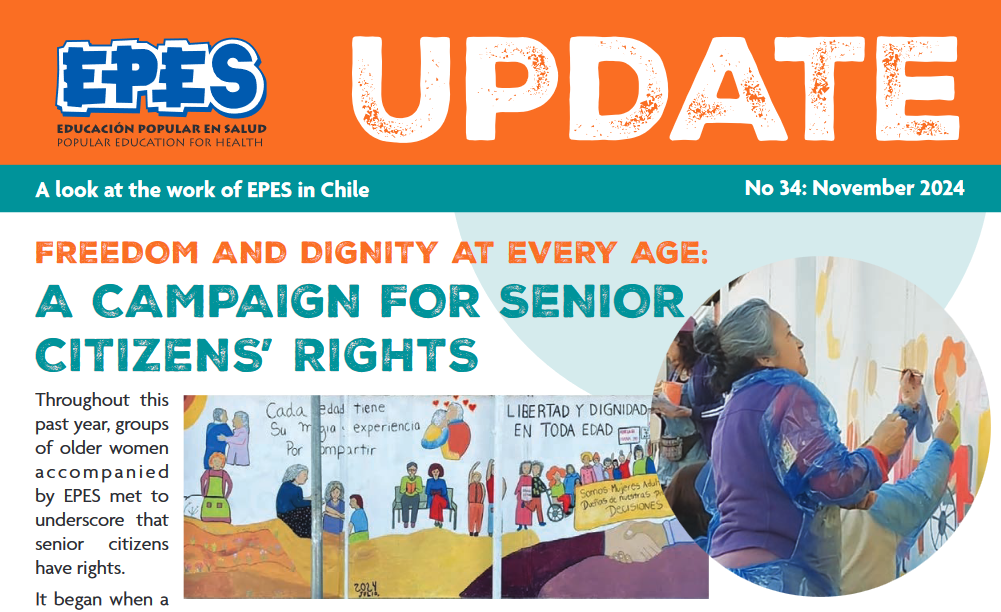
EPES Update – November 2024

Freedom and Dignity at Every Age – Food Sovereignty – Honoring Tere and Charito – Remembering Friends

EPES Update November 2024 Cover Page

Dear friends of EPES,

I can find no better way to open this letter than to quote Rebecca Solnit’s words on November 7 to millions of brokenhearted Americans:

You may need to grieve or scream or take time off, but you have a role no matter what, and right now good friends and good principles are worth gathering in. Remember what you love. Remember what loves you. Remember in this tide of hate what love is.The pain you feel is because of what you love…Take care of yourself and remember that taking care of something else is an important part of taking care of yourself…

Even EPES, born in the darkest days of the military dictatorship, has survived (and thrived) for 42 years in part because they have always remembered, in a tide of hate, what love is. And because they knew instinctively the importance of self-care to being able to continue the struggle for health and dignity.

For EPES, 2024 has been a year notable for challenges and changes. It began with a strategic re-envisioning exercise that produced a decision to close the Concepción office and concentrate operations in Santiago, a process that will be complete by the end of the year. Another major change comes with the retirement of two key members of the team, Rosario Castillo and María Teresa Fuentealba. You’ll read about their legacy in this Update.

You’ll also see that, despite institutional and personnel change, EPES has maintained a steady pace of work on behalf of health and dignity for the Chilean people. You’ll read of important developments in the programmatic area of food sovereignty and community gardens, continuing Spanish-language training for Haitian women, and of the way EPES’ International Course on Popular Education and Participatory and Community Strategies for Health (the Escuela) continues to extend its influence beyond Chile’s borders. A more recent initiative has to do with the rights of senior citizens, with activities in both Concepción and Santiago, including murals, exercise programs, and workshops on such topics as self-care, digital technology, active aging, and visual health.

Finally, on a more somber note, you’ll read of the loss of three important members of the EPES family: Carol Larkin and Sheila Dauer of the AHA board, and Vicky Norambuena, of the Concepción team. Three new scholarships have been established in their names to be awarded to students of the XIV Escuela in 2025. Vicky died just last month, and it is particularly tragic that she did not survive to be with us this month for the formal closure of the Concepción center and celebration of its history and accomplishments. All three will be sorely missed. We are as saddened by their deaths as we were enriched and gladdened by their presence in life.

Once again, thank you so much for accompanying us on this journey, and for all you do to support EPES’ critical work for health and dignity in Chile.

Be as kind to yourselves as you are to others.We need you. In solidarity and peace,

Christina Mills MD FRCPC

P.S. If you would like to donate directly to one of the scholarship funds, please put Carol, Sheila or Vicky’s name in the memo portion of your check or in the additional comments field online. Gracias!

EPES Update December 2023: Highlighting Community Gardens

Special EPES Update: Commemorating the 50th anniversary of the coup in Chile

Dear friends of EPES,
In this special Update to commemorate the 50th anniversary of the military coup in Chile, we share with you stories from several staff members who have played leadership roles in EPES for the past four decades, and whose lives were changed dramatically by the coup.

Fifty years after Pinochet’s brutal coup, hundreds of people are still looking for their loved ones. Less than one third of the estimated 1,469 disappeared have been identified, and, while President Boric asserts that Chile has a moral duty to keep looking until all are accounted for, the task is monumental. More than 100 people were thrown into the sea from helicopters, making it extremely unlikely their bodies will ever be found. The search continues in the context of ever-more-brazen attempts by Pinochet apologists to justify the Junta’s human rights abuses, saying that “harsh measures” were necessary to save the country. “Harsh” is much too mild a term for kidnapping, torture, murder and forced disappearance.

Other factors that heighten tensions around the upcoming anniversary of the coup are the rejection in last September’s plebiscite of a progressive draft Constitution, ongoing repression of indigenous and environmental activists, and catastrophic flooding this month that has left more than 30,000 people homeless. Activities marking the anniversary began earlier this year and will crescendo as we approach September 11.

EPES and EPES-trained health promoters played important roles in the fight for a return to democracy during the dictatorship, and in demanding that the subsequent elected governments live up to their promises. In this Update, along with personal stories from EPES staff, we highlight some of the activities EPES has been organizing and participating in related to the 50th anniversary.

As always, we thank you for your continuing support. Without it, this important work would not be possible

In solidarity and peace,

Christina Mills MD FRCPC

President, Action for Health in the Americas